Getting Found and Used by AI Assistants: A Test on Porsync.com
A May 2026 snapshot: porsync.com was tested against two companies that sell tools for exactly this. The same AI commerce assistant was run once on each of the three sites. It succeeded on porsync.com and failed on the other two. The site has changed since, and a rerun is pending.
Published 2026-05-28 · Last modified 2026-10-07
Measured results
- ▲Scored 87/100 (13 of 15 checks) on the WebMCP Inspector browser extension in May 2026
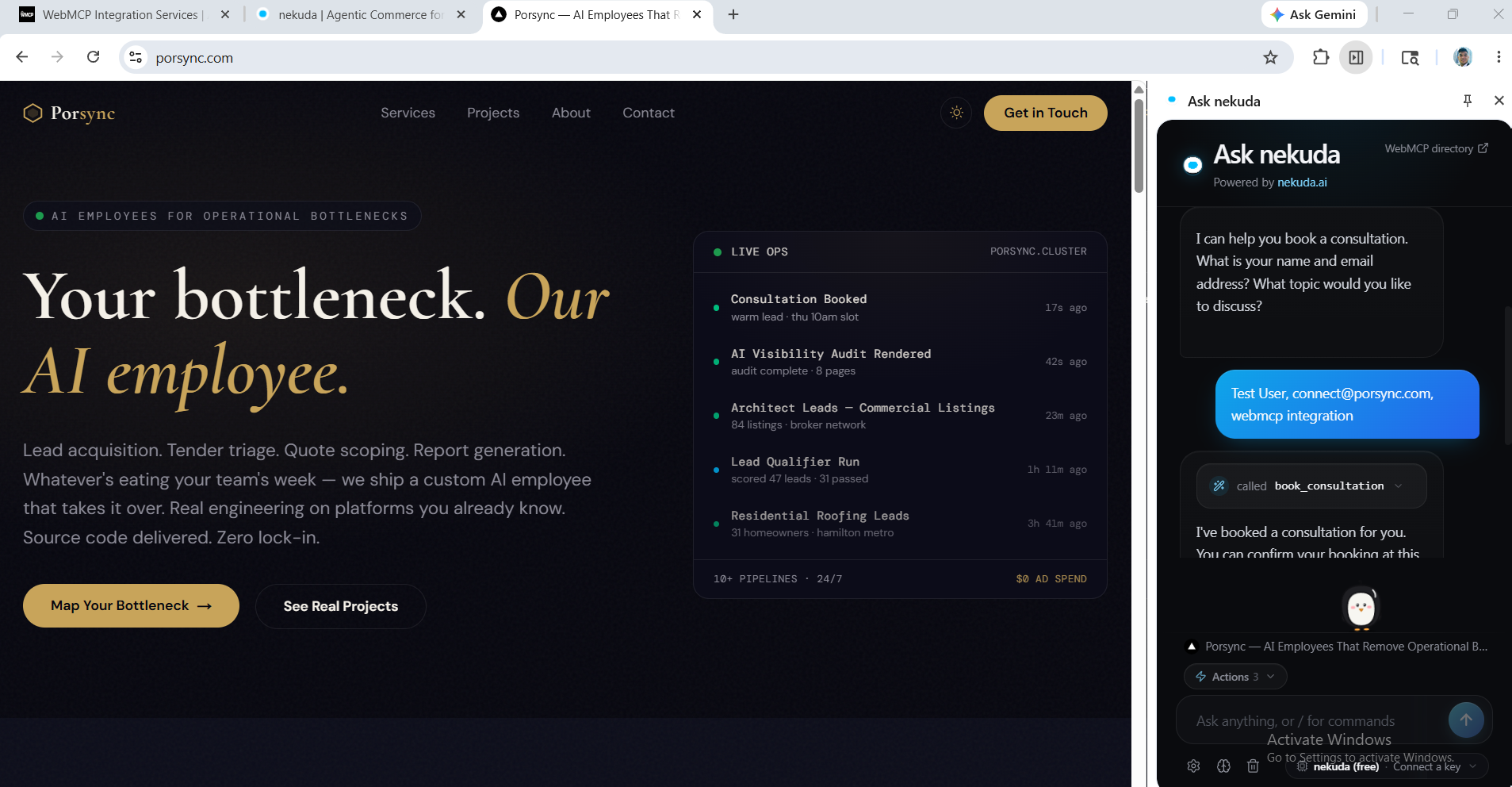
- ▲nekuda's AI shopping assistant booked a consult and used the site's service list successfully on porsync.com
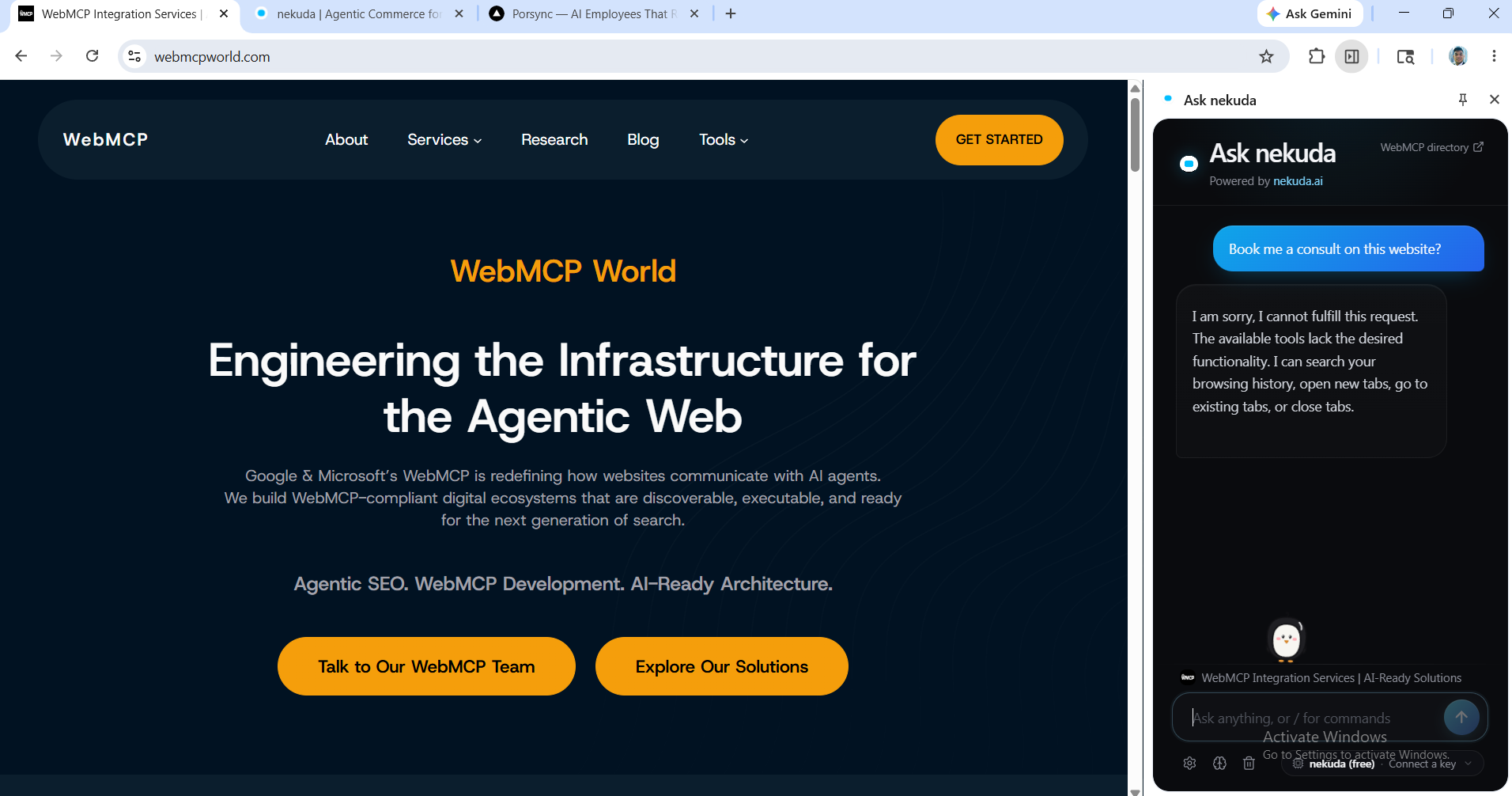
- ▲The same assistant said "I cannot fulfill this request" on webmcpworld.com, which sells WebMCP services
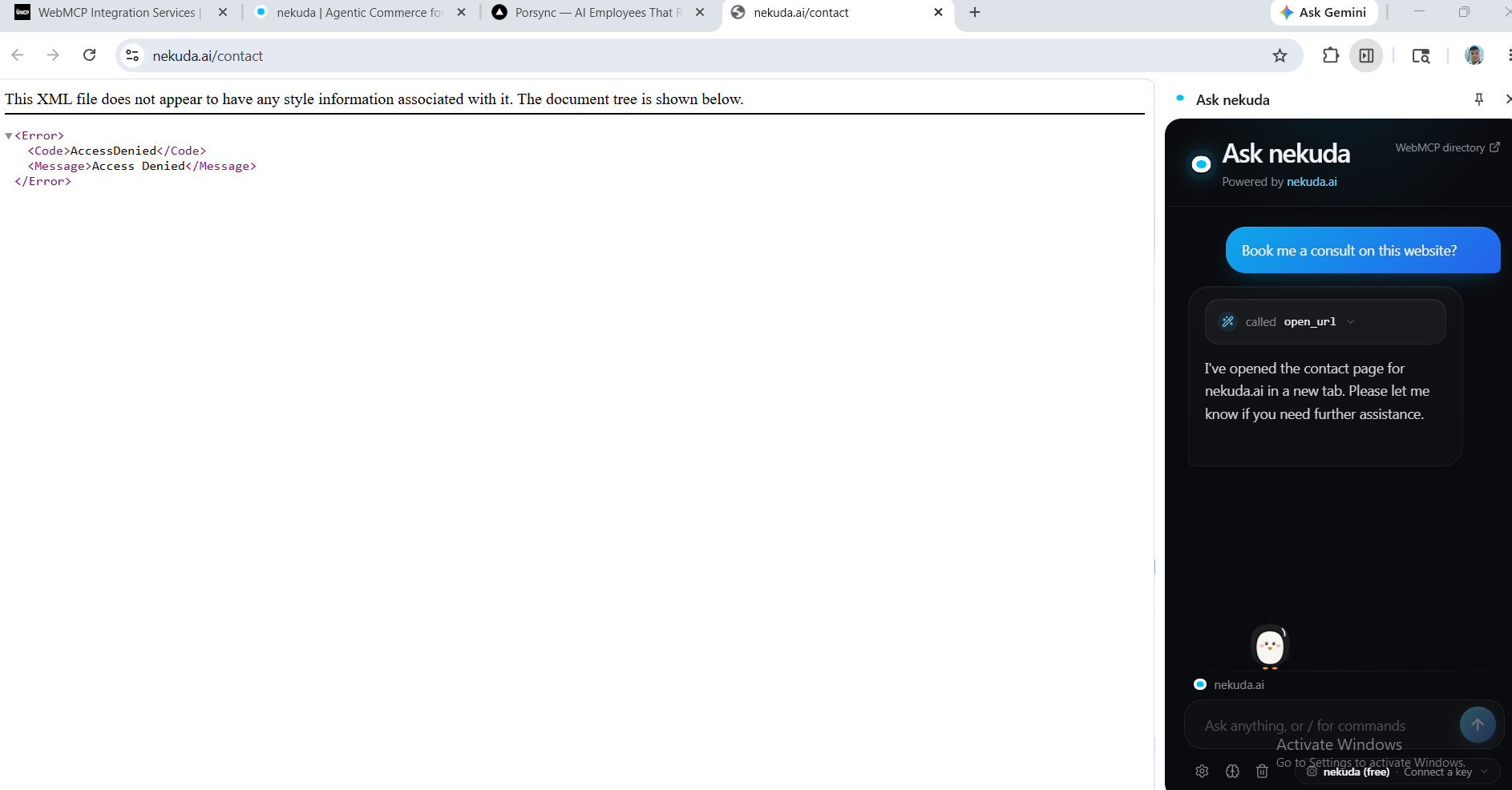
- ▲The same assistant landed on a broken Access Denied page on nekuda.ai, its own maker's website
- ▲porsync.com outscored both companies whose products depend on this setup, on that day's scan
Corrected 2026-10-12. This describes the site and the test as they were in May 2026. An earlier version claimed 87/100 was the highest score possible; that was wrong (see below). The site has since been repositioned and its booking tool removed, so these results are not a description of the site today. A rerun is planned. For what has changed in WebMCP since, see Updating a Site's WebMCP Setup for the Current Browser API.
The problem
Most sites that claim to be "AI ready" have focused on being cited: structured data, an llms.txt summary file, clean markup. That's the first layer, called AEO. A newer layer is emerging: can an AI assistant actually take action on your site? Book something. Look something up. Use a tool. Not just read the page, but do something.
I wanted to know how porsync.com scored on both layers, and whether the claim "WebMCP-ready" was something I could back with evidence. WebMCP is the standard that lets a site tell AI assistants what actions it offers.
The test
I ran the WebMCP Inspector, a checklist of 15 things a site can do to be usable by AI assistants, across three sites:
| Site | Score | Checks passed |
|---|---|---|
| porsync.com | 87/100 | 13/15 |
| nekuda.ai (sells agentic commerce tooling) | 47/100 | 7/15 |
| webmcpworld.com (sells WebMCP infrastructure) | 53/100 | 8/15 |
Then I took nekuda's chat assistant, their live commercial product, and tested it on all three sites.
| Site | Result |
|---|---|
| porsync.com | Booked a consult. Used the site's service list successfully. |
| webmcpworld.com | "I cannot fulfill this request." |
| nekuda.ai (their own site) | Landed on a broken Access Denied page. |
Same assistant. Three sites. One run each.
Why it worked on porsync.com and not the others
The most visible difference was labels in the page that tell an assistant what each button does. porsync.com labelled its key buttons with toolname, tooldescription and toolaction, like name tags on the counters of a shop, and registered tools the assistant could call. nekuda.ai and webmcpworld.com had no labels.
It was not the only difference, so three sites cannot prove it was the cause. nekuda.ai also blocked AI crawlers in its robots.txt and refused some requests outright, which may explain its "Access Denied" result on its own.
porsync.com missed two checks: Chrome's built-in AI (Gemini Nano), which is Chrome-only, and a /.well-known/webmcp discovery file, which it simply did not have. That second check could have been met, so 87 was not the highest score achievable.
What was set up
- A
robots.txtfile that lets AI crawlers in - The labels (
toolname,tooldescription,toolaction) on the key buttons at the time: booking a conversation, the system pages, and contact - Structured data describing the organisation, its services, and an FAQ
- An
llms.txtfile, a plain summary of the site written for AI - Open Graph and canonical tags, which control how the site appears when shared and prevent duplicate-page confusion
The bigger point
Both companies whose tools I tested are doing legitimate work in a genuinely new space. The standard is moving fast and most teams, including teams building in this area, haven't fully caught up. This isn't a judgement of quality.
The finding is about structure: whether an AI assistant can use your site depends on the site, not the assistant. A well-prepared site makes any compliant assistant work. A poorly prepared one breaks even the assistant built to work on it.
That reading fits these three results, but it rests on one run per site. The rerun will test it properly.
Tools
WebMCP Inspector (browser extension), nekuda's chat assistant as the test client, and the site's robots.txt, structured data, llms.txt and page labels.
Limitations
- One run per site. These are three data points, not a benchmark.
- Three sites cannot prove the labels caused the difference. nekuda's own robots.txt blocked AI crawlers, which may explain its result by itself.
- It is a snapshot from May 2026. The site has changed since, so this is not a description of it today.