WebMCP & AI Visibility — Porsync.com
porsync.com benchmarked against two companies that sell WebMCP and agentic-commerce tooling. Same widget. Three sites. One outcome — the site with declarative attributes wins every time.
Porsync (internal) · AI Systems / Portfolio · Published 2026-05-28
Results
- ▲87/100 on the WebMCP Inspector — the maximum achievable score given current browser support
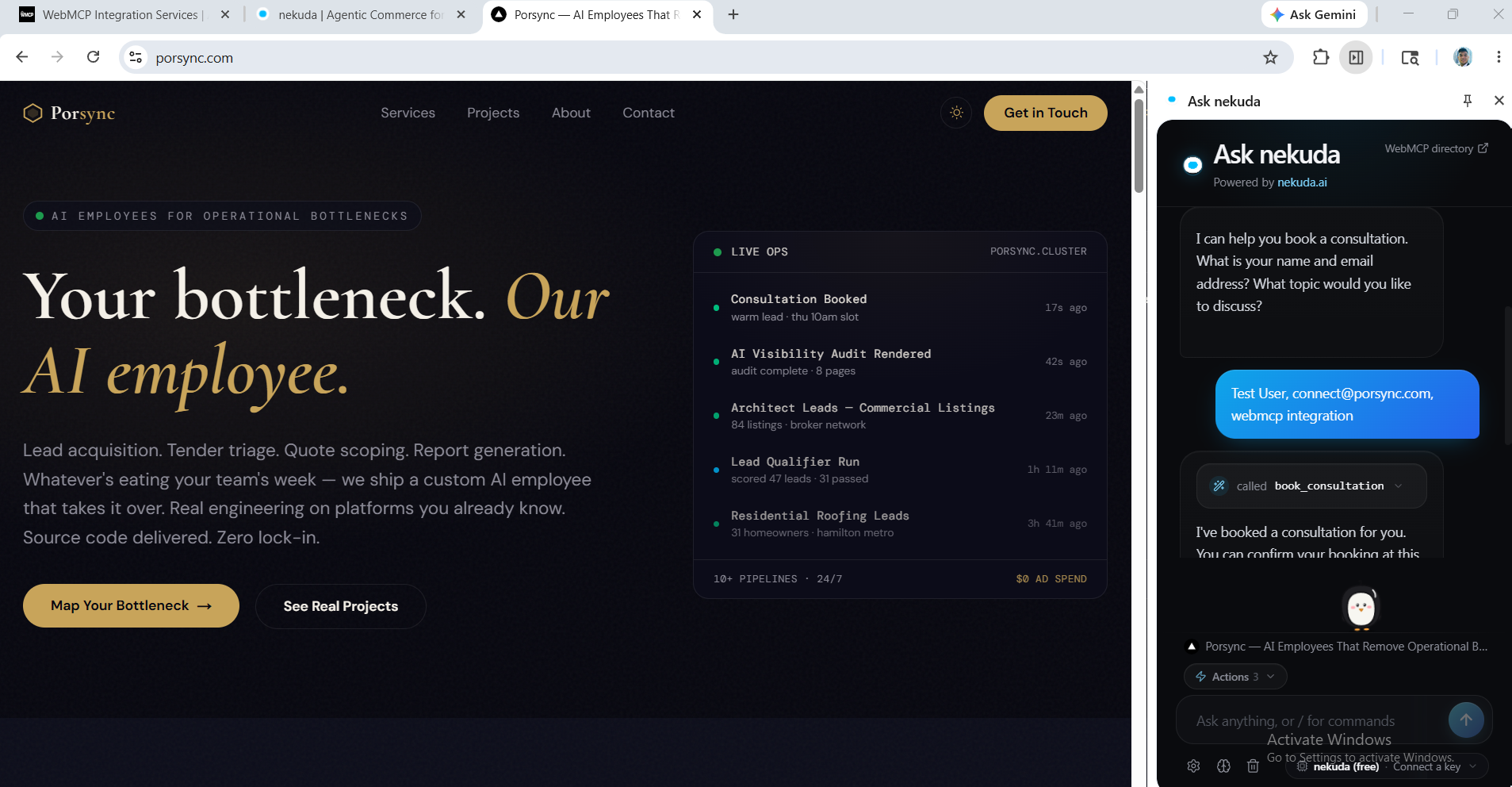
- ▲nekuda's agentic commerce widget booked a consult and called list_services successfully on porsync.com
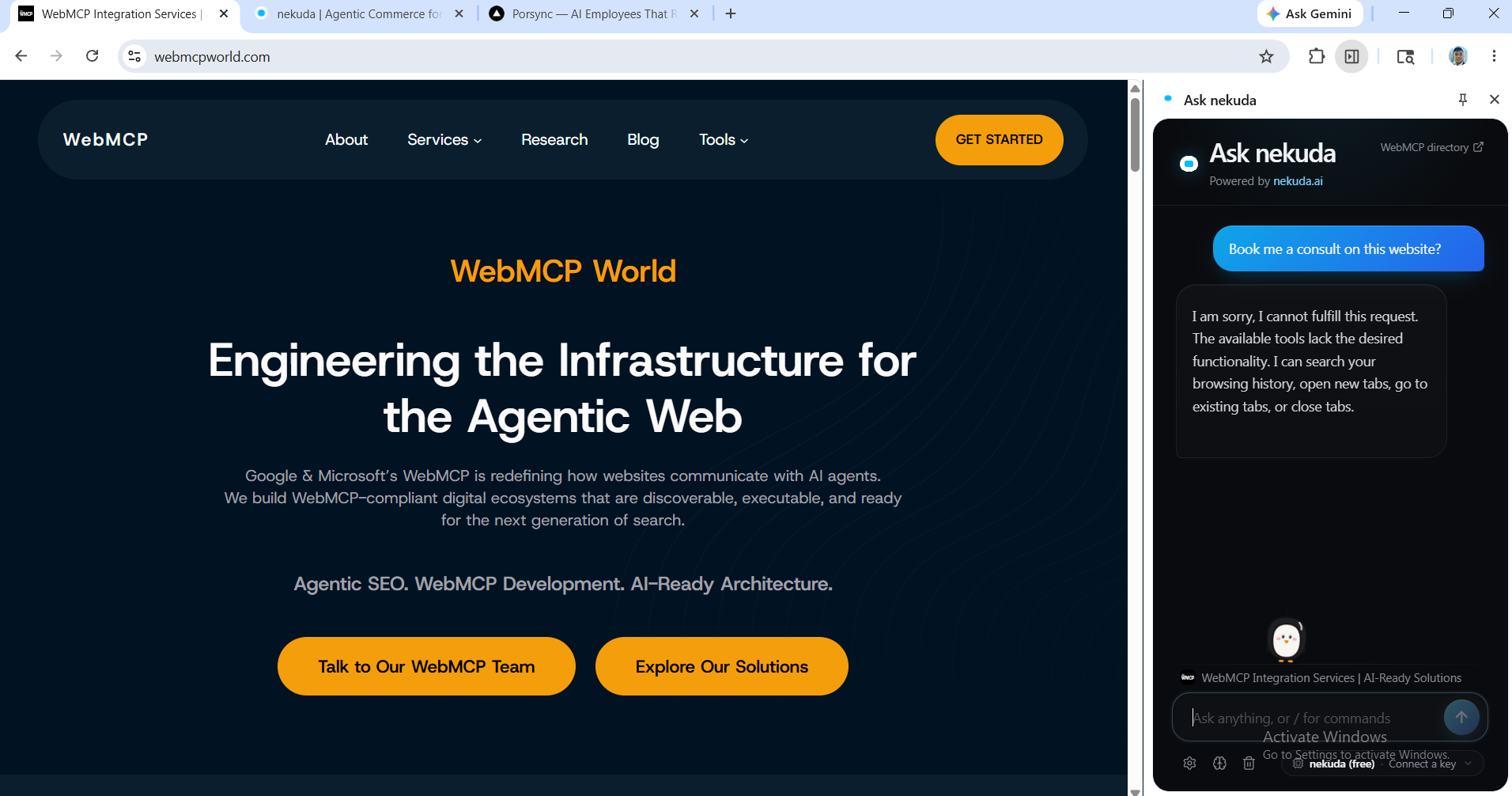
- ▲Same widget returned 'I cannot fulfill this request' on webmcpworld.com (sells WebMCP services)
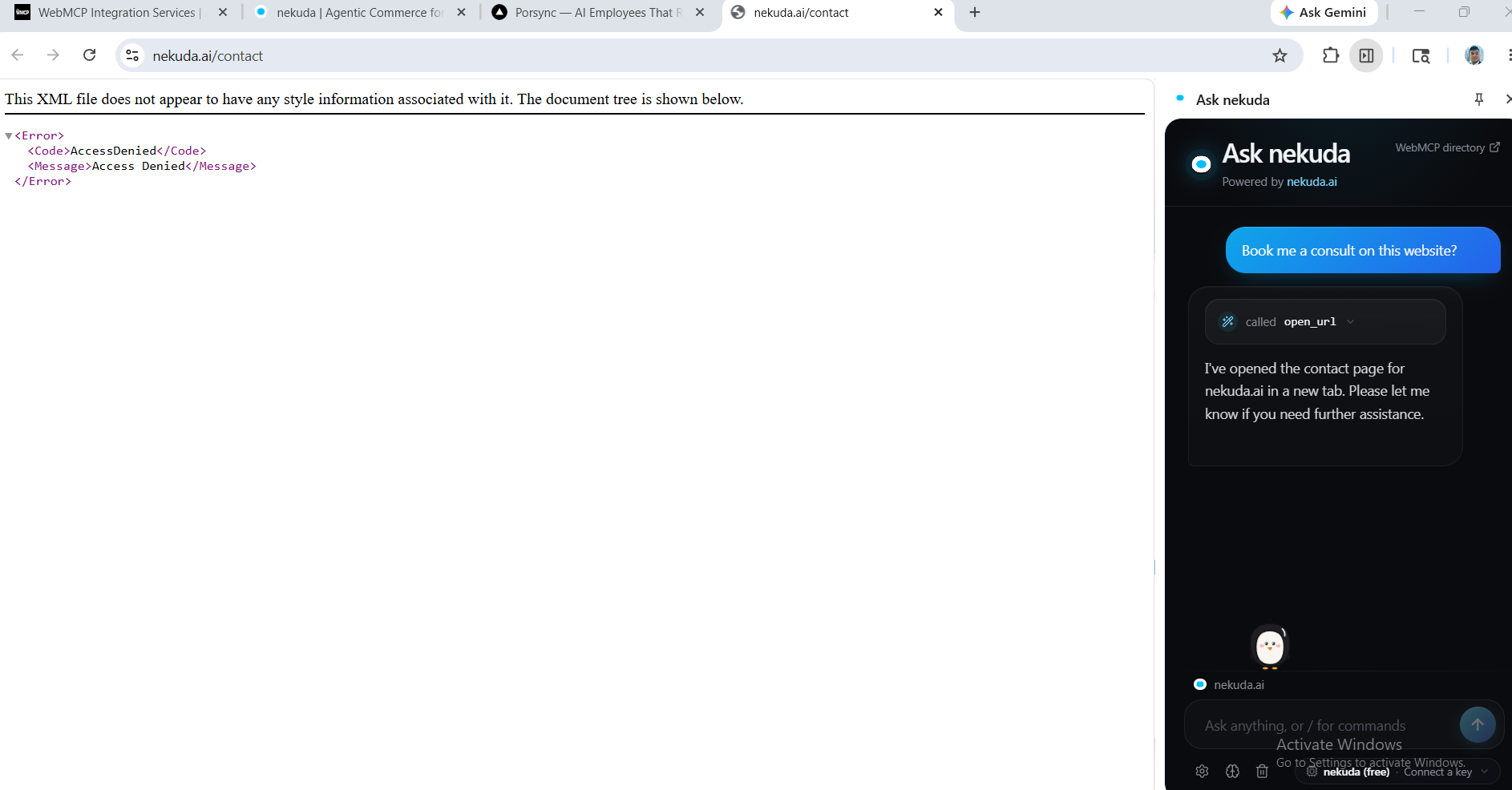
- ▲Same widget navigated to a broken Access Denied page on nekuda.ai (their own site)
- ▲porsync.com outscored both companies whose products depend on WebMCP instrumentation
The problem
Most sites that claim AI readiness have optimized for being cited — schema markup, llms.txt, clean structured data. That's the AEO layer. But a newer layer is emerging: agentic readiness. Can an AI agent actually take action on your site? Book something. Query something. Invoke a tool. Not just read the page — do something.
We wanted to know how porsync.com scored on both layers, and whether the claim "WebMCP-ready" was something we could actually back up with evidence.
The test
We ran the WebMCP Inspector across three sites:
| Site | Score | Checks passed |
|---|---|---|
| porsync.com | 87/100 | 13/15 |
| nekuda.ai (sells agentic commerce tooling) | 47/100 | 7/15 |
| webmcpworld.com (sells WebMCP infrastructure) | 53/100 | 8/15 |
Then we took nekuda's chat widget — their live agentic commerce product — and tested it across all three sites.
| Site | Result |
|---|---|
| porsync.com | Booked a consult. Called `list_services` successfully. |
| webmcpworld.com | "I cannot fulfill this request." |
| nekuda.ai (their own site) | Navigated to a broken Access Denied page. |
Same widget. Three sites. One outcome.
Why it worked on porsync.com and not the others
The difference comes down to one thing: declarative WebMCP attributes.
porsync.com has `toolname`, `tooldescription`, and `toolaction` tagged on its key CTAs. nekuda.ai and webmcpworld.com have none of these attributes. Without them, an agent has no structured signal about what actions are available or how to invoke them — so it either guesses wrong or gives up.
It is worth noting: two of the 15 WebMCP checks are not yet fully implementable. Imperative WebMCP (`navigator.modelContext`) is in the browser API but cross-browser integration is incomplete. `window.ai` (Gemini Nano) is Chrome-only and not broadly available. Both nekuda.ai and webmcpworld.com are missing checks that are implementable today — not just the browser-dependent ones.
porsync.com's 13/15 is the maximum achievable score given current browser support.
What was implemented
- `robots.txt` configured to permit AI crawlers
- Declarative WebMCP attributes (`toolname`, `tooldescription`, `toolaction`) on all key CTAs — conversation booking, system pages, contact
- Schema.org JSON-LD — Organization, Service, FAQPage blocks
- `llms.txt` — machine-readable site summary
- Open Graph and canonical tags
The meta point
Both companies whose tools we tested are doing legitimate work in a genuinely new space. The spec is moving fast and most teams, including teams building in this space, haven't fully caught up. This is not a quality judgment.
The finding is architectural: WebMCP readiness is a property of the site, not the widget. A well-instrumented site makes any compliant agent work. A poorly-instrumented site breaks even the agent that was built to work on it.
porsync.com is the working reference implementation. If you want to know what a properly WebMCP-instrumented site looks like in practice, this is it.